
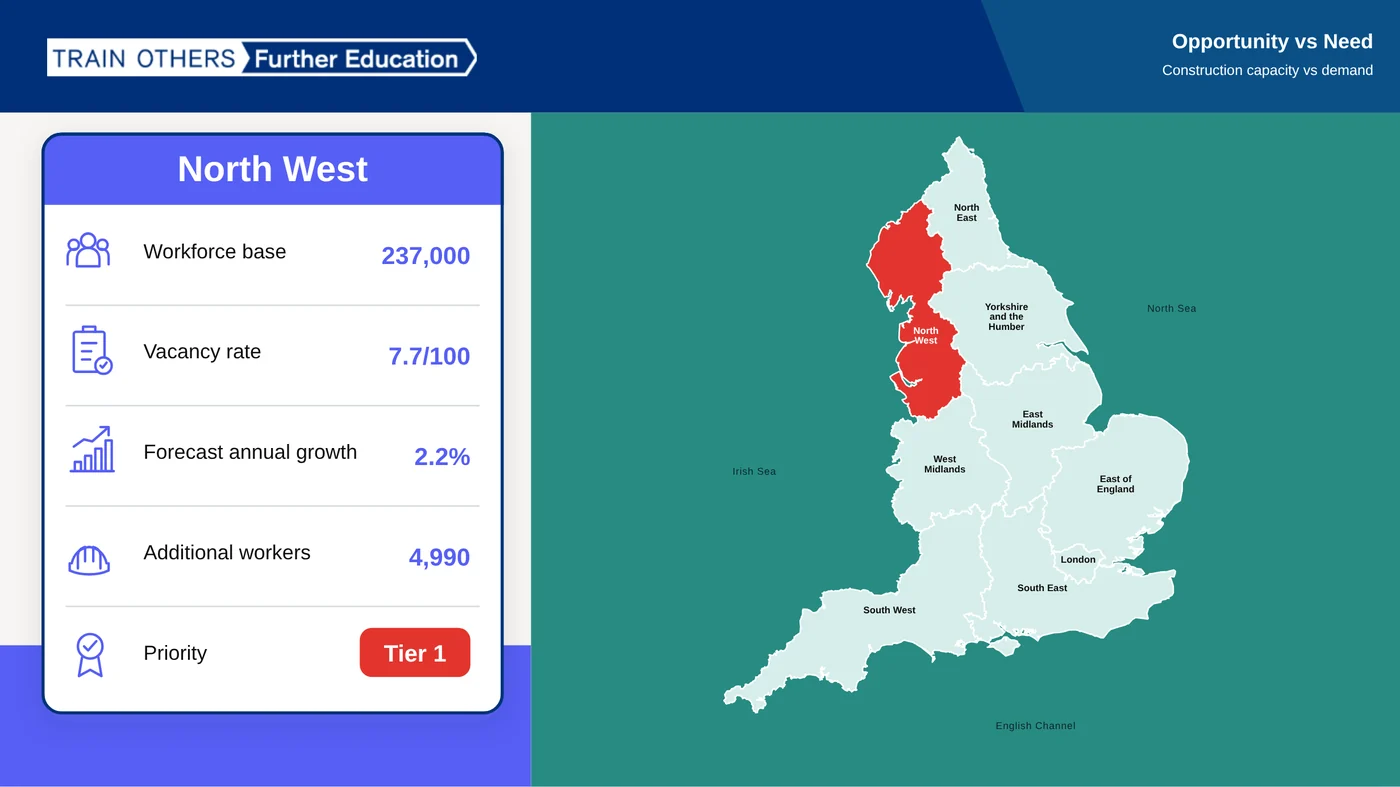
The North West has 7.7 unfilled college construction teaching posts per 100, above England's 7.2, with about 4,990 more builders needed here every year to 2030.
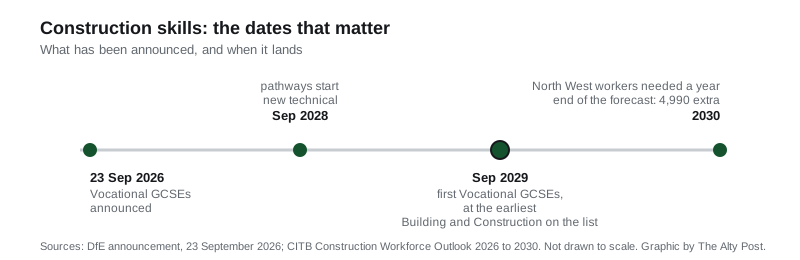
Ministers announced on 23 September that teenagers in England will be able to take new Vocational GCSEs, and that Building and Construction is one of the subjects being considered for the first wave in 2029. The Department for Education spent this week pushing the question that follows: who is going to teach them.
Its own analysis, sent to us on Thursday, says the North West has 7.7 unfilled further education teaching vacancies in construction for every 100 posts, against an England average of 7.2. It is the highest regional rate in the department’s figures. One of the two trainers the department offered for interview works for Trafford’s own college group.
The figures the department is using
The analysis is called Local Builders, Local Futures and it stacks three datasets on top of each other: the Further Education Workforce Data Collection for teaching vacancies, the Construction Industry Training Board’s forecasts for demand, and Office for National Statistics JOBS05 data for the size of the existing workforce.
For the North West it produces this:
- 7.7 unfilled construction teaching vacancies per 100 further education posts, against 7.2 for England
- 2.2 per cent forecast average annual growth in construction output between 2026 and 2030
- about 4,990 additional construction workers needed each year over that period
- an existing regional construction workforce of about 237,000 as of March 2026
The forecast figures come from the CITB Construction Workforce Outlook 2026 to 2030, which covers the UK, the devolved nations and the nine English regions. The vacancy rate is the department’s own analysis of college workforce returns and is not published as a standalone release, so it is the department’s number rather than one we can check against a register. The notes to editors in the release we were sent head the same five figures “West Midlands findings”, which is a labelling slip: the body of the release and the regional graphic both attribute them to the North West.
What was actually announced this week
The wording matters here, because the press release we were sent describes “the introduction of a Construction GCSE from 2029” and the government’s own announcement is more careful than that.
The Department for Education said on 23 September that new Vocational GCSEs will sit alongside traditional GCSEs, will be nationally set with content based on subject expert advice, will be graded and regulated by Ofqual, and will eventually replace the Technical Awards schools offer now. They are “set to be available in some subjects from as early as September 2029, as part of broader new technical pathways starting in September 2028”. The subject options it lists “could include” Business Management and Finance, Creative Media Production, Digital Tech, Child Development, and Building and Construction.
So construction is on the list, the list is not final, and 2029 is the earliest date rather than a fixed one. The same announcement launched a National Mission on Work Experience, a call for employers to provide an extra 200,000 placements for 14 to 16 year olds, naming construction companies as one of the sectors wanted. Employers are asked to contact their local Careers Hub.
Who teaches the trades in Trafford
The department named James Hollingworth, from Manchester, as a local trainer available to talk to. He is a plastering trainer at Stockport College, part of The Trafford and Stockport College Group, and the campaign says he spent 18 years in the trade, including running his own plastering business, before moving into teaching, and that he was inspired by his late grandfather, a college lecturer. The release calls the employer “Trafford College Group”, which is the group’s former name.
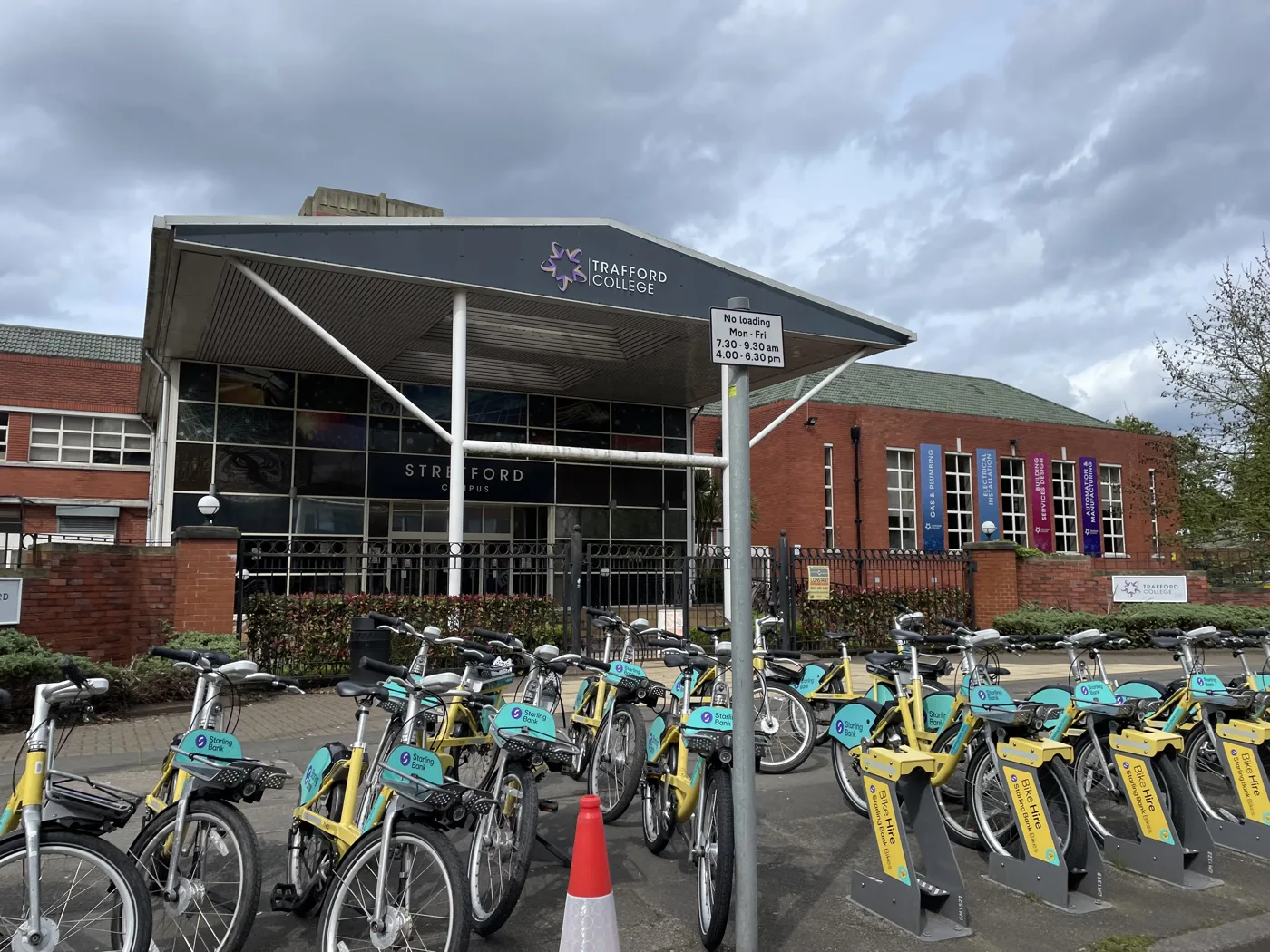
That group is the main further education provider for this part of Greater Manchester. It runs Trafford College, Stockport College, Cheadle College and Marple Sixth Form. Trafford College itself has two campuses, one on Manchester Road in West Timperley, Altrincham, WA14 5PQ, and one at Stretford, which the college says covers computing, science, engineering, electrical and motor vehicle. The Stretford building, pictured above, carries course banners for gas and plumbing, electrical installation, building services design, and automation and manufacturing.
The second trainer offered was Dave Love, from Bolton, head of apprenticeships at Wigan and Leigh College, a former electrician and business owner who the campaign says moved into further education after being encouraged by one of his own tutors.
“Training others does not mean starting again”
Christian Thersby, principal at West Lancashire College, spent eight years in the chemical industry before moving into further education. In the release he said:
“One of the things industry professionals bring to FE is an authentic, real-world perspective. Their experience helps learners understand what working in construction is really like, while ensuring training remains aligned to current industry practices, employer expectations and the skills the sector needs both now and in the future.
The most rewarding part of being an FE trainer is helping learners build confidence, develop practical industry skills and take the next step towards a successful career in construction. Seeing how their skills and confidence grow is a great reminder of the impact Further Education can have.
For anyone working in construction and considering a change, I’d encourage them to explore becoming an FE trainer. Colleges provide support and the opportunity to complete teaching qualifications on the job. Your industry experience could help inspire and develop the next generation of construction professionals.”
Tim Balcon, chief executive of the CITB, said:
“The North West needs skilled construction workers to support its future growth, but it also needs experienced people who can train them.
“Thousands of people across the region have spent their careers supporting others and solving practical problems. That experience is exactly what further education colleges value.
“Training others does not mean starting again. It is a chance to pass on the standards and knowledge that matter to industry, and help build a future-ready, skilled workforce in the North West.”
What it means for you
If you work in a trade here. Colleges are recruiting from industry across bricklaying, carpentry, plumbing, electrical work, plastering, site management, quantity surveying and civil and structural engineering. The department says previous teaching experience is often not required, that colleges can support new trainers to gain a teaching qualification while working, and that full-time, part-time and flexible contracts exist depending on the college. The campaign site is Teach in Further Education, and its jobs section lists vacancies. Locally, the college group advertises its own posts on its vacancies page and gives recruitment@tscg.ac.uk as the contact.
If you have a child at school. Nothing changes for this year’s Year 9 choices. The new technical pathways start in September 2028 and the first Vocational GCSEs follow from September 2029 at the earliest, so the Technical Awards schools currently offer continue until they are replaced.
If you are wondering where the building work is. Trafford has plenty coming. The borough is consulting on a Local Plan that includes 373 homes on local sites, the Carrington relief road goes to committee on 15 October, and the former Kellogg’s site at Trafford Park is earmarked for 45,000 square metres of employment space rather than housing. Every one of those needs people who can lay bricks, wire buildings and fit pipes, which is the argument the department is making.
Sources
- New Vocational GCSEs unveiled in major shake-up to hands-on learning for teens, Department for Education, 23 September 2026, for the qualification, the 2028 and 2029 dates, the subject list and the work experience mission.
- Construction Workforce Outlook 2026 to 2030, Construction Industry Training Board, for the regional output and workforce forecasts.
- Teach in Further Education, Department for Education, for the campaign and the routes into training.
- The Trafford and Stockport College Group for the colleges in the group, its Trafford College page for the two campuses, and its recruitment site for the Altrincham campus address and the recruitment contact.
- The Local Builders, Local Futures analysis and the regional figures were supplied to us by the campaign’s press office on 24 September 2026.
Have your say