
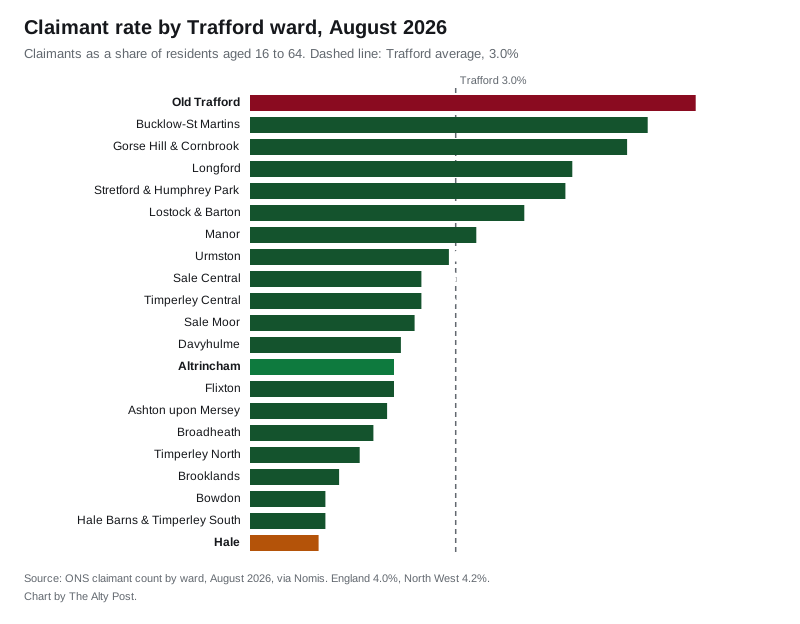
Old Trafford's claimant rate is 6.5%, level with Oldham, the highest borough in Greater Manchester. Hale's is 1.0%. August 2026 figures for all 21 wards.
Trafford has one of the lowest claimant rates in Greater Manchester. The borough figure hides a gap of more than six to one between its wards.
In Old Trafford, 6.5% of residents aged 16 to 64 were claiming unemployment-related benefits in August 2026. That is level with Oldham, the highest of Greater Manchester’s ten boroughs. In Hale it was 1.0%.
The figures are the Office for National Statistics claimant count, published through Nomis. The August release came out in September.
The borough figure
- 4,495 people in Trafford were counted as claimants in August 2026.
- That is 3.0% of residents aged 16 to 64.
- It is up 130 on July (4,365) and up 230 on August 2025 (4,265).
- England’s rate was 4.0% and the North West’s 4.2%.
Trafford and Stockport share the lowest rate in Greater Manchester, 3.0%. Oldham has the highest at 6.5%, with Manchester and Rochdale on 6.0%.
The ward gap
Trafford has 21 wards. Five of them, in the north and west of the borough, have rates above 4.5%. Bucklow-St Martins covers Partington and Carrington; the other four are in Old Trafford and Stretford.
| Ward | Claimants | Rate (16 to 64) |
|---|---|---|
| Old Trafford | 575 | 6.5% |
| Bucklow-St Martins | 380 | 5.8% |
| Gorse Hill & Cornbrook | 535 | 5.5% |
| Longford | 345 | 4.7% |
| Stretford & Humphrey Park | 365 | 4.6% |
Those five wards account for 2,200 claimants, about half the borough total.
The lowest rates are all in the south:
| Ward | Claimants | Rate (16 to 64) |
|---|---|---|
| Hale | 65 | 1.0% |
| Bowdon | 65 | 1.1% |
| Hale Barns & Timperley South | 65 | 1.1% |
| Brooklands | 85 | 1.3% |
| Timperley North | 110 | 1.6% |
Altrincham ward sits near the middle, at 2.1% (155 claimants). Broadheath is on 1.8% (140), Timperley Central on 2.5% (165) and Sale Central on 2.5% (165).
Where this year’s rise has landed
Nomis publishes figures for Trafford’s current wards from January 2026. The borough count rose from 4,300 in January to 4,495 in August, an increase of 195.
Four wards account for almost all of it:
- Old Trafford: 500 to 575, up 75
- Bucklow-St Martins: 330 to 380, up 50
- Gorse Hill & Cornbrook: 500 to 535, up 35
- Stretford & Humphrey Park: 335 to 365, up 30
Together that is 190. Across the other 17 wards the total fell slightly, by about 10. Hale went from 85 to 65 and Ashton upon Mersey from 145 to 120.
Ward counts are rounded to the nearest five, so small changes should be read as approximate.
What the count measures
The claimant count covers people on Jobseeker’s Allowance and people on Universal Credit who are required to look for work. It is not the same as the unemployment rate, which comes from a survey. Some people on Universal Credit who are in work but earn little are included, which is one reason the count can rise when jobs are not being lost.
The rate is claimants as a share of all residents aged 16 to 64 in the ward.
What it means for you
Trafford’s 3.0% is the figure usually quoted for the borough, and it is the lowest in Greater Manchester. It is an average of very different places. In Hale, Bowdon and Hale Barns about one working-age adult in a hundred is claiming. In Old Trafford it is about one in fifteen, a rate no Greater Manchester borough exceeds.
If you are judging the local jobs market for a business, a school or a charity bid, use the ward figure rather than the borough one. All 21 are in the chart above.
We will update these figures when the September count is published.
Sources
- ONS claimant count by ward, Trafford, August 2026 and January 2026, via Nomis for every ward count and rate.
- ONS claimant count, Trafford, England and the North West, via Nomis for the borough, regional and national figures.
- ONS claimant count, Greater Manchester boroughs, August 2026, via Nomis for the comparison with the other nine boroughs.
- Nomis: claimant count dataset for the definition of the count.
Have your say