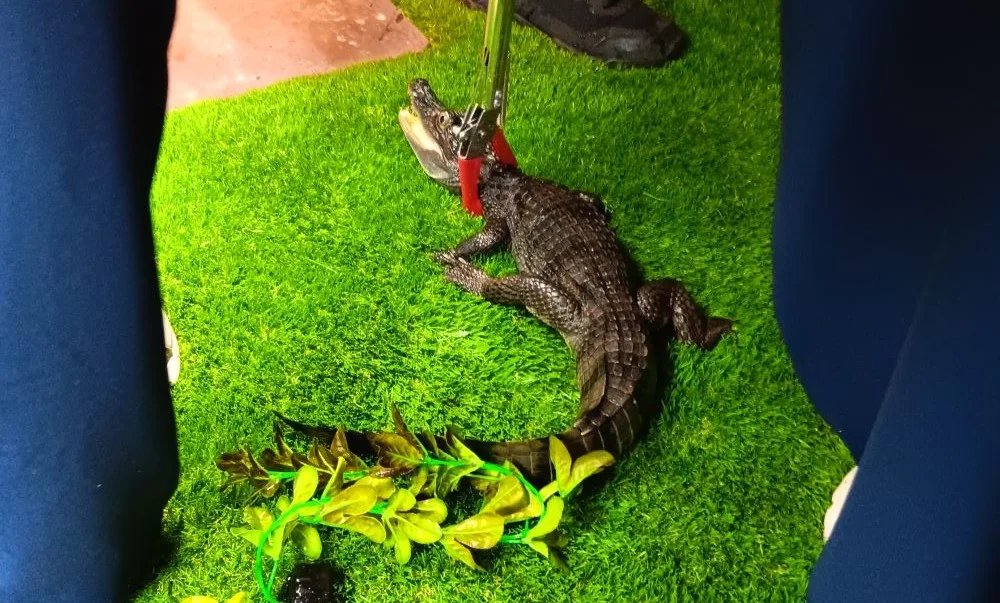

A spectacled caiman called Lyle was taken from a Hale home with no dangerous wild animal licence, plus a python. What the law requires, and the £2,000 fine.
A spectacled caiman, a species of crocodilian, has been taken from a semi-detached house in Hale. Trafford Council says it was being kept without the licence the law requires for a dangerous wild animal.
The animal, called Lyle, was found in an enclosure with water. A python was also taken from the house so police could assess it under the Animal Welfare Act.
The council announced the seizure on 17 September. Its environmental health team led the operation under a warrant, with Greater Manchester Police and the RSPCA. The council acted on reports that the caiman had no Dangerous Wild Animal Licence.
Where the animals went
Both reptiles went first to a local vet that specialises in reptiles. The council said the caiman was being moved to a suitable zoo on the day it announced the seizure.
According to the council, caimans:
- have sharp teeth and strong jaws, and carry a biting risk
- can grow to more than two metres long
- are native to much of Latin America
The council has not named the keeper, and neither do we. It has not said whether any further action will follow.
What they said
Cllr Keleigh Glenton, the council’s executive member for community safety, said species like this need “sensitive, expert handling and proper environments”. She said the council does “not hesitate to take decisive action when rules are not adhered to”.
Sergeant DeGouveia, GMP’s wildlife lead, thanked the Altrincham Neighbourhood Team, the RSPCA and the council.
Evie Button, the RSPCA’s exotic animals expert, said the charity was “deeply concerned that so many dangerous wild animals continue to be kept in private hands across Britain”.
What the law requires
Keeping a caiman is not illegal in itself. It needs a licence from the council, under the Dangerous Wild Animals Act 1976. The species covered are listed in a 1984 order made under the Act.
Trafford’s licence page says that before it grants one, it must be satisfied that:
- keeping the animal is not against the public interest, for safety, nuisance or other reasons
- the applicant is a suitable person
- the accommodation is secure, big enough, well built and kept clean
- the animal will get enough food, drink, bedding and exercise
- vet care, fire precautions and disease control are in place
- the keeper holds suitable insurance
An authorised vet inspects the premises before any licence is granted, and the keeper pays for that inspection. A licence covers only the person and the address named on it, and it runs out on 31 December each year.
The penalties
The council says a keeper can be fined up to £2,000 for:
- keeping a dangerous wild animal without a licence
- breaking the conditions of a licence
- obstructing or delaying an inspector or vet
The council can also seize, rehome or destroy the animal, and charge the keeper the costs.
What it means for you
If you keep, or plan to keep, an exotic animal in Trafford, check the 1984 list before you buy. A licence is needed before the animal arrives, not after. Refused applicants can appeal to the magistrates’ court.
If you are worried about an animal kept near you, the council’s animal licence pages say welfare concerns or nuisance can be reported by email to animal.welfare@trafford.gov.uk. If an animal is loose or someone is in danger, call 999.
Have your say